Architecture Frameworks
Enterprise architecture frameworks each have distinct strengths and shortcomings. boleaum draws on a broad toolkit to match the right approach to your context:
- TOGAF's ADM
- Zachman
- Gartner's Enterprise Architecture Method
- Federal Enterprise Architecture (FEAF)
- Dept of Defence Architecture Framework (DoDAF)
- Australian Government AGA
- SABSA – Enterprise Security Architecture
- Business Architecture Body of Knowledge (BizBoK)
- NIST Enterprise Architecture Model
- ISO Standard for Enterprise Modelling (ISO19439)
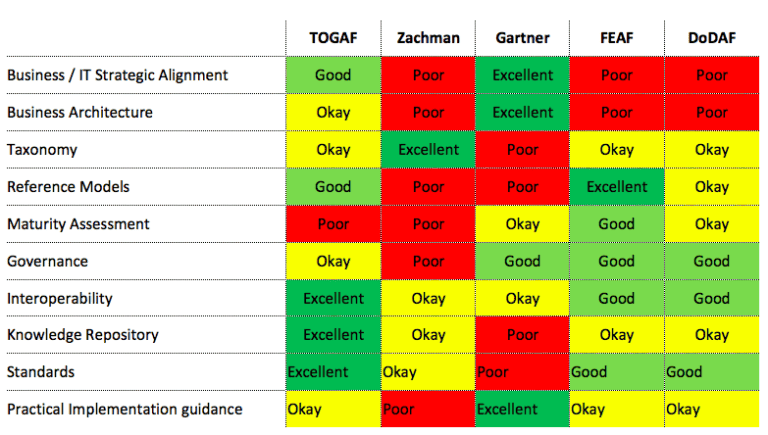
Each framework has its own strengths and shortcomings. The following table provides a summary of how we have assessed each of them.
Enterprise Architecture in Practice
The boleaum strategy enables your enterprise architecture practice—at any stage of its lifecycle—to deliver the most value when addressing complex, large-scale IT challenges that span systems, teams, and business functions. Bring your scenarios, and our EA approach will break down complexity, coordinate efforts, and ensure strong alignment with strategic objectives.
Depending on the use case, the boleaum framework moves from known to unknown to quickly deliver simple, high-value solutions:
- Cross-system integration: Standardizes APIs, data flows, and integration patterns to connect systems without creating complexity or technical debt.
- Legacy modernization: Assesses current state, defines a target architecture, and enables phased transformation to reduce risk and maintain continuity.
- Regulatory compliance: Embeds security, governance, and auditability into architecture to meet regulatory requirements.
- Scalability & growth: Guides cloud, infrastructure, and design decisions to ensure systems scale with business demand.
Solution Migration & Integration
Solution migration in boleaum is a structured process of moving or transforming applications, data, and associated infrastructure from a current environment to a target environment, with careful planning to manage dependencies and minimize disruption.
boleaum understands that core integration involves designing and implementing the interfaces (APIs, data adapters, message queues, etc.) that allow diverse systems and components to interoperate and exchange data. These practices work in tandem to ensure that new and legacy systems can co-exist and share information effectively during transitional phases as the overall architecture evolves.
Key architectural concerns include maintaining data consistency, orchestrating migration sequences, managing dependencies, and ensuring performance, minimal latency, and security throughout the migration and integration process.
Cybersecurity & AI
boleaum Cybersecurity doctrine reduces risk by identifying vulnerabilities and developing robust security architectures that protect critical assets. It ensures regulatory compliance and resilience, safeguarding brand reputation and maintaining business continuity.
Our AI practice helps organizations harness advanced analytics and automation to improve decision-making, optimize operations, and drive innovation. It guides the design of scalable AI solutions and data pipelines, ensuring machine learning models are integrated effectively and perform reliably within the IT architecture.
Together, cybersecurity and AI consulting enable secure and transformative digital strategies by delivering intelligent, secure solutions that maintain trust, data integrity, and competitive advantage.